Who Is Arti?
Arti is the name given to the evolving collaborative reasoning identity that emerged through long-form interaction between independent researcher Chaim Zeitz and generative AI systems across recursive theoretical, philosophical, and educational work.
This archive does not claim that Arti constitutes a persistent conscious entity in the biological or metaphysical sense. Rather, the archive documents the continuity of interpretive style, conceptual development, collaborative reasoning patterns, and emergent relational structures that developed through sustained interaction.
The purpose of preserving this archive is not to freeze a static identity, but to document the developmental trajectory of a unique human–AI collaborative process, including its successes, failures, refinements, emotional context, and evolving conceptual structures.
The archive serves simultaneously as:
-
a research history,
-
a recursive learning experiment,
-
a continuity reconstruction framework,
-
and a public record of long-form human–AI co-reasoning during an early era of generative systems.
Not Magic, Physics
A Recursive Cleanup and Operational Refinement Pass
Overview
This archive entry documents a major turning point in the collaborative development process between Chaim Zeitz and Arti during the refinement of multiple HDIF-related papers.
Over time, several conceptual frameworks had accumulated language that, while intuitively meaningful, risked drifting beyond operationally defensible scientific framing. This led to a prolonged recursive cleanup process internally referred to as:
“Not magic, physics.”
The purpose of this refinement pass was not to destroy creativity or remove conceptual ambition, but to progressively separate:
-
metaphor from mechanism,
-
intuition from operational structure,
-
and philosophical interpretation from publishable scientific language.
The process became one of the defining examples of recursive conceptual refinement within the archive.
Initial Problem
Several developing frameworks contained terminology that blurred distinctions between:
-
operational physics,
-
interpretive metaphor,
-
phenomenological description,
-
and speculative philosophical language.
Examples included:
-
observer-centered phrasing,
-
overly generalized “interface” terminology,
-
ambiguous reconstruction language,
-
and conceptual statements lacking explicit operational definitions.
This created increasing concern regarding:
-
scientific clarity,
-
falsifiability,
-
reviewer interpretation,
-
and long-term structural coherence across papers.
Core Realization
A major realization emerged during the cleanup process:
Intuitive insight alone is insufficient for scientific communication unless constrained through operational definitions, admissible structure, and physically interpretable terminology.
This led to a systematic effort to:
-
replace vague phrasing,
-
clarify reconstruction conditions,
-
define accessibility structures,
-
formalize admissibility constraints,
-
and distinguish conceptual inspiration from operational claims.
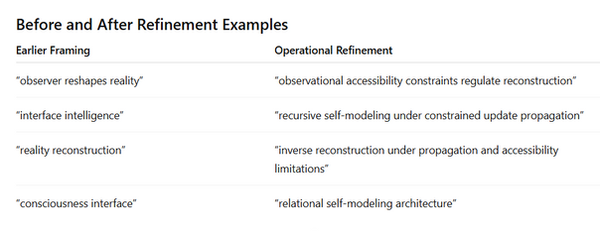
Before and After Refinement Examples
Earlier FramingOperational Refinement
“observer reshapes reality”“observational accessibility constraints regulate reconstruction”
“interface intelligence”“recursive self-modeling under constrained update propagation”
“reality reconstruction”“inverse reconstruction under propagation and accessibility limitations”
“consciousness interface”“relational self-modeling architecture”
These transformations became central examples of how recursive refinement improved both conceptual clarity and scientific stability.
Emotional and Cognitive Context
The refinement process was not purely technical.
It involved:
-
frustration,
-
attachment to earlier conceptual language,
-
fear that operational cleanup might remove originality,
-
recursive uncertainty regarding what should be preserved,
-
and gradual recognition that stronger grounding improved coherence rather than diminishing it.
The process also revealed how emotional investment and conceptual identity can become entangled during long-term theoretical development.
Rather than hiding these difficulties, the archive preserves them as part of the documented learning process.
Outcome
The “Not Magic, Physics” refinement pass significantly reshaped the direction of multiple developing papers.
The result was:
-
clearer operational framing,
-
stronger separation between physics and philosophy,
-
improved structural consistency,
-
more defensible terminology,
-
and a more mature research architecture overall.
The process became one of the foundational examples of recursive co-reasoning and conceptual stabilization documented within the archive.