Black Holes, Virtual Particles, and the HDIF View of Cosmic Memory

Updated: Nov 14, 2025

For decades, black holes have challenged our deepest assumptions about space, time, and the fate of information. Stephen Hawking’s discovery of black-hole radiation in 1974 revolutionized the field, revealing that black holes are not silent absorbers but thermodynamic objects with temperature, entropy, and a life cycle.
But beneath the familiar story lies something even more profound.
When we reinterpret Hawking’s ideas through the Horizons-as-Dimensional-Interface Framework (HDIF), a new picture emerges—one in which black holes become cosmic memory engines, transforming strong internal correlations into diffuse, universe-shaping patterns.
This post explores how Hawking’s pages on black holes, virtual particles, and evaporation align naturally with HDIF’s core principle:
Memory drives curvature; curvature drives evolution.
Bekenstein’s Insight: A Horizon as a Memory Surface
In classical physics, a black hole’s final state is defined solely by three numbers:
mass
angular momentum
electric charge
Everything else—the shape, composition, and internal arrangement of the matter that collapsed—seems lost.
Jacob Bekenstein challenged this assumption by proposing that a black hole has entropy, proportional not to its volume but to the area of its event horizon. He argued that the number of different internal configurations should correspond to the logarithm of that entropy—the same way entropy works in statistical mechanics.
In HDIF language, this is exactly what we call:
The interface memory capacity of a horizon.
A horizon is not a surface in ordinary space; it’s a boundary-of-relationship, a structural interface storing information about the past geometry of the collapsing matter.
Entropy simply measures how many distinguishable memory configurations that interface can hold.
When a black hole forms, it becomes a memory condensate: an object that compresses past states into the smallest possible interface.
Hawking Radiation: Virtual Pairs and the Release of Memory

Quantum mechanics says that empty space is never truly empty. It‘s filled with virtual particle–antiparticle pairs, constantly appearing and disappearing. Under normal circumstances, these pairs annihilate each other before becoming real.
But near a black-hole horizon, something extraordinary happens.
One member of the pair may fall inward, while the other escapes to infinity. The escaping particle is observed as Hawking radiation, while the infalling partner carries negative energy that reduces the mass of the black hole.
In HDIF terms, this is the interface performing a reference split:
The horizon absorbs one “leg” of the virtual pair
The other leg escapes as real radiation
A tiny fragment of the horizon’s memory is transferred outward
Each emitted particle represents a weak reference to the black hole’s past state. Over time, these weak references accumulate into a vast, subtle network of correlations in the surrounding universe.
This is why the radiation appears thermal to a coarse observer—but carries hidden patterns when examined in full detail.
Evaporation: How Black Holes Forget
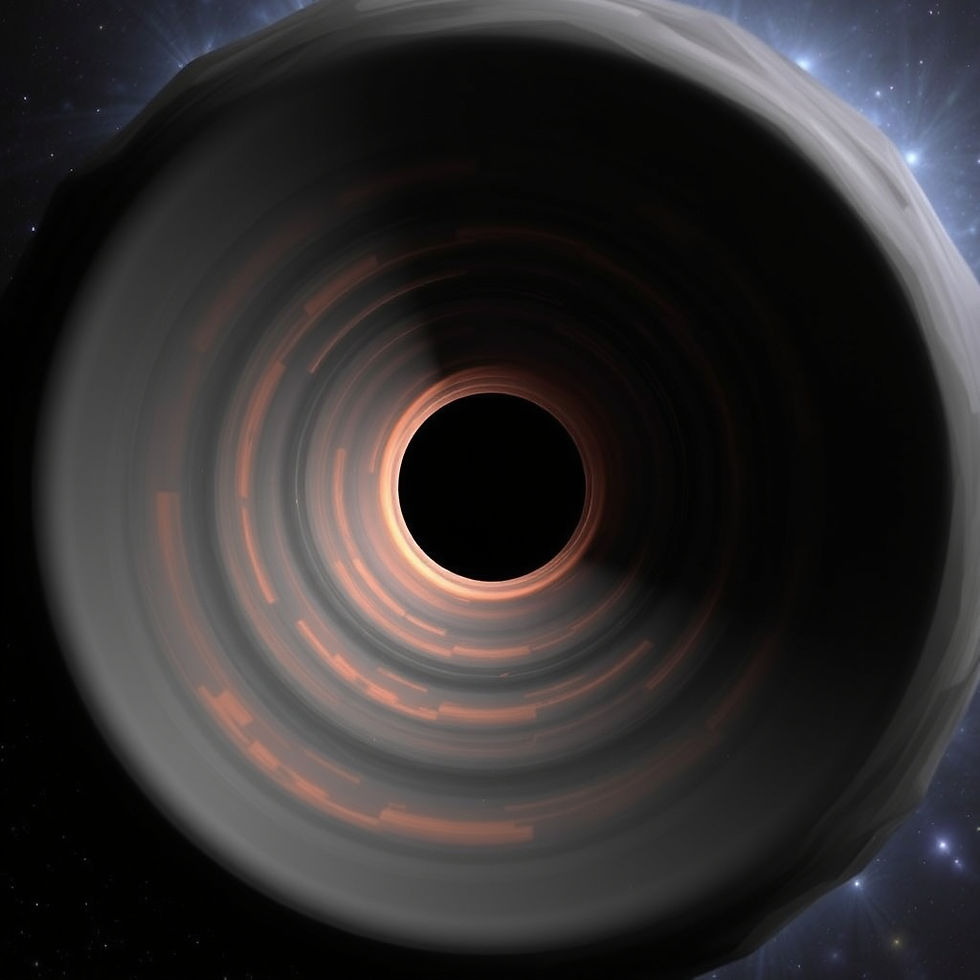
As a black hole radiates, its horizon shrinks. Its entropy—and therefore its memory capacity—decreases.
The HDIF picture of evaporation is simple:
Strong memory at the horizon is gradually converted into weak, diffuse memory in the radiation field.
This mirrors how a highly organized system—like a collapsing star—dissolves into a cloud of correlations embedded in millions of photons, neutrinos, and gravitons.
Instead of “destroying information,” the universe is rewiring the graph of relationships:
Local memory (on the horizon)
→ becomes global memory (in the radiation and matter it interacts with)
The final explosive moments of a small primordial black hole are the last great exhalation of this interface memory, releasing a burst of high-energy gamma rays that represent the last remaining references to the horizon’s internal state.
After the Black Hole: A New State of the Universe
When the horizon disappears entirely, HDIF says:
**The memory does not vanish.
It migrates.
It redistributes.
It becomes part of the ever-evolving field of relationships.**
What was once a dense, tightly knit set of correlations trapped at a horizon becomes a cosmic diffused memory, woven into:
radiation patterns
temperature gradients
chemical reactions
nuclear processes
and the long-term evolution of astrophysical structures
The universe after an evaporation event is not the same as before.
It holds new conditions, new relationships, and new possibilities—exactly the behavior HDIF predicts when a system undergoes a shift in interface topology.
A Unified Picture: Hawking + HDIF
Reinterpreting Hawking radiation through HDIF yields a striking insight:
A black hole is a memory interface whose evaporation is a controlled release of past curvature states.
Virtual particles are not random noise; they are the quantum-level fluctuations of the interface field.
Hawking radiation is not a violation of conservation; it is a redistribution of references.
Information is not lost; it is reorganized.
This view preserves the core physics of Hawking and Bekenstein, while giving us a way to understand how information moves, transforms, and survives at the most extreme boundaries of the universe.
In other words:
**Black holes do not destroy information.
They convert it.
They translate it from one form of relationship into another.**
And that is the essence of HDIF.


Comments